What is chords progression?
- the sequence of chords pattern repeatedly or non repeatedly appeared in a song
- Usually represented by Romans numbering
How does knowing chords progression benefit you?
- help us in memorizing the chords pattern in a song
- Recognizing the chord pattern in a song and use number. Eg G,Em,C,D is 1,6,4,5
- It is easier to transpose song by using chords progression numbering
- Eg. V (1,5), Ch (6,1,4), B (1,4,5)
Guitar Strings Frequency Chart (Guitar Tuning Chart)

Every Amateur Does Get Better Eventually
Eve and Adam Devoted to God in Beautiful Eden
Eve and Adam Desire God in Blessed (Bountiful) Eden
In Eden, Adam Dated Gougeous Beautiful Eve
EdgeAB E (A) D. G (B) E
Every Awesome Day God Bless Everyone
Eve and Adam Desire God’s Blessing Everyday
Guitar Capo Chart
Play In (the written key) Sung in (count down to the singing key, then Capo)

How to use the above Capo Chart?
For Example
If people request a song to be sung in A Key, But the Score is written in G (You Play in G), you need to Capo 2nd Fret and You Play in G
If people request a song to be sung in Eb Key, But the Score is written in A (You Play in A), you need to Capo 6th Fret and You Play in A
If people request a song to be sung in B Key, But the Score is written in E (You Play in E), you need to Capo 7th Fret and You Play in E
How to know where to Capo without referring to the Capo Chart?
Use the Fingering Chord shape of the key (You press the G chord), move down the fret and count down
To put it simply, play in the written key, then count down to the singing key.
For Example
If the Song is sung in key A, but the chords are written in key G (hence you are forced to play in G), Press in G Shape Chord on the guitar with your finger then move down, (G#, A), Hence Capo 2 fret down and play in G.
If the song in sung in key E, but the chords are written in key A (hence you are forced to play in A), Press in A Shape Chord on the guitar with your finger then move down, (A#, B, C, C#, D, D#, E), Hence Capo 7 fret down and play in A.
If the song is sung in key B, but the chords are written in key E (hence you are forced play in E), Press in E Shape chord on the guitar with your finger then move down, (F, F#, G, G#, A, A#, B), Hence Capo 7 fret down and play in E.
The weakness of using Capo is, you can only move up, cannot move down
For example, if the song in play in D, but sung in C, you can't use Capo already
Guitar Chord Chart

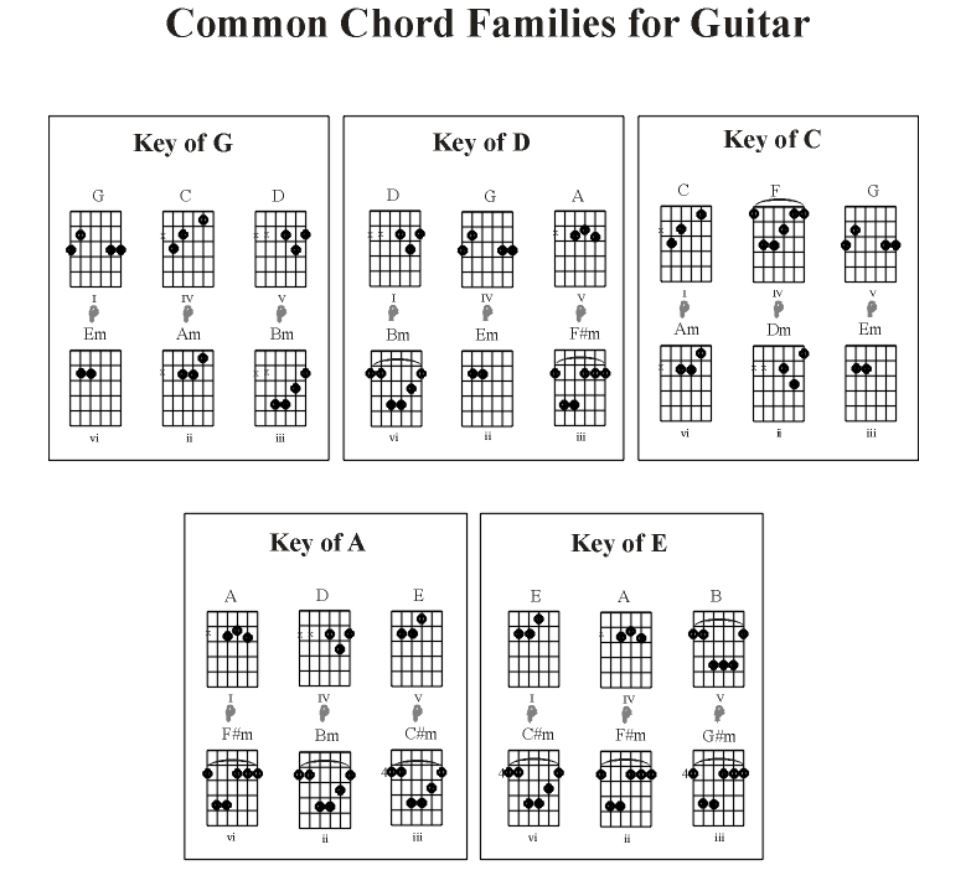
Chord Family Chart

Guitar Chord Family Chart

Common Chord Family Chart for Guitar
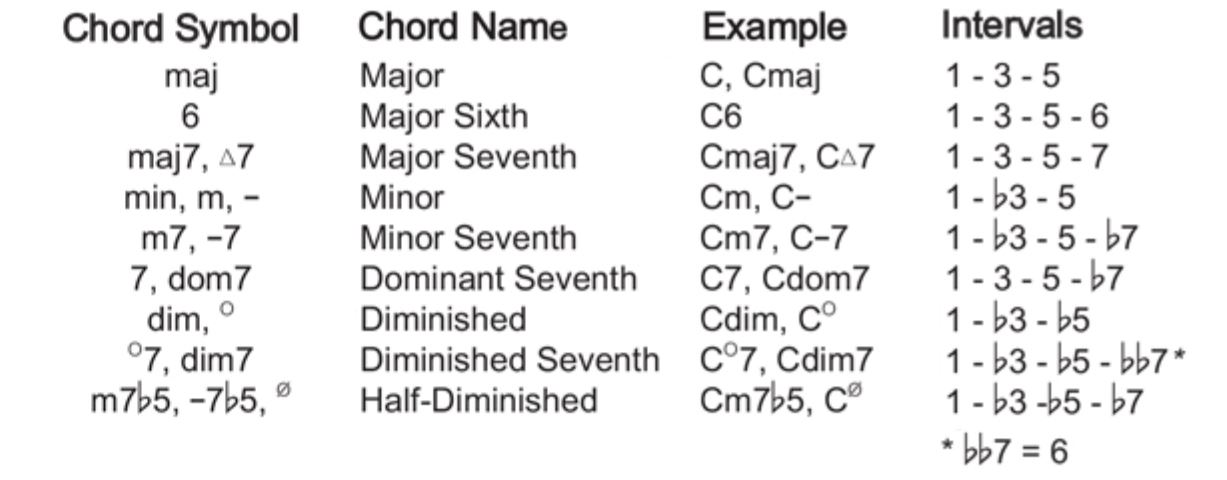
Major: 1-3-5
Minor: b3 or (minor 3rd or flat 3rd), 1-b3-5
7th: b7 (or minor 7th), 1-3-5-b7
min7: b3, b7 (or minor 3rd and 7th), 1-b3-5-b7
Major7: add 7 (or add maj 7), 1-3-5-7
sus: suspend 3rd note, replaced by or add 2nd and 4th note, 1-2-4-5
sus2: suspend 3rd note, replaced by or add 2nd note, 1-2-5
sus4: suspend 3rd note, replaced by or add 4th note, 1-4-5
Diminished (o): b3 and b5, 1-b3-b5
Augmented (+): #5, 1-3-#5
5 (C5): Power Chord, 1-5 or 1-5-1
6 (C6): Add 6, 1-3-5-6
9 (C9): 1-3-5-b7-9
Maj9 (Cmaj9): 1-3-5-7-9
2 (C2): Add 2, 1-2-3-5
Add9: Add 9, 1-3-5-9
C2 and Cadd9 is off the same tone because 2 and 9 is the samae tone
For more chords, refer to Guitar Chords LibraryCircle Of Fifth & Circle Of Forth

The Purpose
The Purpose of the Circle of 5th (fifth) is more form
1. Finding a Key has how many sharps or Knowing the key based on the number of #s and bs
- Keyboardists must know
- Guitarists follow chords pattern or fingering might not too interested to know
2. Finding out what are the 6 chords in a Key family. A Chord Progression Road Map
- When we talked about Chord Progression, we are talking about what are the 6 chords in a particular key family.
The Count
1. Clockwise Counting to find the next Key (Chord)
- Count 5 (Diatonic scale count, Inclusive of the 1st and 5th chords)
- Diatonic count is 7 notes. W-W-H-W-W-W-H Intervals
- Count 8 (Chromatic scale count (12 Half Steps), Inclusive of the 1st and 5th chords)
- Chromatic count is 8 notes (inclusive) or 7 Half Steps
- Counting Clockwise is to emphasize the # (sharps)
2. Anticlockwise Counting to find the next Key (Chord)
- Count 4 (Diatonic scale count, Inclusive of the 1st and 4th chords)
- Diatonic count is 7 notes. W-W-H-W-W-W-H Intervals
- Count 6 (Chromatic scale count (12 Half Steps), Inclusive of the 1st and 5th chords)
- Chromatic count is 6 notes (inclusive) or 5 Half Steps
- Counting Anticlockwise is to emphasize the b (flats)
No such thing as Cbm because Cb is B, B no no sharp
No such thing as Fbm becayse Fb is E, E no sharp
That's why on the circle of 4th, left side (anti-clockwise), it is Cm (even with 3 flats) and Fm (even with 4 flats)
No comments:
Post a Comment