The Power Of Praise & Worship and The Real Estate In Singapore

The Power Of Praise & Worship and The Real Estate In Singapore
Presented to you by Property Smart Investor- A Real Estate Online Education and Discussion

Sunday, 5 April 2015

Time to switch to a fixed-rate home loan? Beware penalty fees and lock-in period - The Sunday Times ST - 5 Apr 2015


Experts give tips as such packages become more popular amid rising benchmarks


Beware penalty fees and lock-in period

The very real prospect of higher housing loan repayments is prompting many home owners to move to fixed-rate mortgages.

These loans have rates that are set for a certain period, usually over two to five years, so customers have certainty about the level of their repayments.

Many home owners are aware that the Singapore Interbank Offered Rate (Sibor), a key rate used to price most home loans, has been creeping up and is now at a level that has not been seen since December 2008.

The three-month Sibor hit 1.01959 per cent last Thursday, up from 1.01446 last Tuesday, with more increases to come once rates in the United States start to rise.

Moving to a fixed-rate loan would make sense for many, but there are factors to consider first, say banks and mortgage brokers.

Know the difference

Many home buyers are now on floating-rate loans, where the interest rate is pegged to market benchmarks such as the Sibor or, less commonly, the Swap Offer Rate (SOR).

The bank usually tacks on a pre-mium, also known as a spread, to the benchmark rate.

These packages became popular when interest rates plunged to near zero after the financial crisis, but times are changing and the spotlight is turning to fixed-rate loans.

Ms Tok Geok Peng, executive director of secured lending at DBS Bank, says such packages offer greater stability as the housing loan rate is set for a period of time.

Pros and cons of fixed-rate loans

The fixed-rate loan will not be affected by the Sibor increase, but the trade-off is that the fixed interest rate will be higher than those of the floating-rate package.

Ms Sandhya Devanathan, retail products head in Singapore at Standard Chartered Bank, warns: "Some fixed-rate packages may be subject to a fee if the borrower were to do a partial prepayment or a full redemption of his loan during the lock-in period."

Fixed-rate loans are also more suitable for owner-occupiers and those with a longer investment time horizon, notes Mr Lim Beng Hua, head of secured loans at UOB Singapore.

When to switch?

Mr Keff Hui, a broker at Mortgage Supermart Singapore, feels it is time to switch "as we are now only in the very early stages of an impending interest upswing cycle".

Based on recent analyst estimates, he says, the Sibor is likely to reach 1.5 per cent by the end of the year and possibly 2.5 per cent by the end of next year.

"If that estimate holds true, adding a mark-up spread of about 0.75 per cent to 0.85 per cent, we would be seeing home loans at a minimum of between 2.25 and 3.35 per cent by the end of 2016."

He adds that ever since the sharp increase in the Sibor in early February, banks have been revising their fixed-rate packages every one to two weeks. Current promotional rates for a two- to five-year fixed-rate home loan range from 1.5 per cent to 2.28 per cent.

"Some banks may also impose conditions for only owner-occupied properties, while some banks may have a minimum loan amount," says Mr Hui.

Mr Sean Lim, founder of FindAHomeLoan.co, brings up an overlooked guideline in reference to the Total Debt Servicing Ratio (TDSR) framework, where some home owners are exempted.

The TDSR caps a borrower's total debt repayments at 60 per cent of gross monthly income.
It is applicable to home owners who refinance existing property loans on or after June 29, 2013.

If you bought a residential property before the TDSR rules kicked in and you occupy it, banks are not required to apply the 60 per cent threshold at refinancing.

Banks also do not need to apply the 60 per cent threshold for an investment property bought before the introduction of the TDSR, if the owner applies for refinancing before June 30, 2017 and commits to a debt-reduction plan.

Mr Lim says: "Now might be the last opportunity to secure attractive fixed-rate packages, as most banks have revised them upwards."

Selecting what's right for you

FindAHomeLoan.co's Mr Lim says a home owner needs to ask these questions:
  • Am I holding the property for the short or medium term?
  • Do I need TDSR exemption?
  • What is my comfort level if interest rates continue to rise?
DBS Bank's Ms Tok says: "Regardless of interest rate trends, we strongly advise anyone with a housing loan to set aside funds as a buffer against interest rate hikes or any unforeseen circumstances."

It is ideal to set aside some savings in cash or liquid assets that can be used to pay for monthly instalments for the next two years.

Ms Tok says this would give home owners sufficient time to restructure their loan or even sell the property if they run into any financial issues.

Home owners should also approach their bank early for help in restructuring their loans if they have difficulties keeping up with monthly repayments.

For an idea of what is out there, DBS offers loan packages that cap the interest rate at a certain level if the reference rate keeps rising.

UOB's Homestar is a variable package pegged to the bank's floating board rate, with the loan tied to a current account. Under this package, if the home owner has an outstanding loan of $500,000 and deposits $100,000 in the current account, interest is charged on $400,000.

UOB notes that besides looking at the interest rate, owners should assess the other terms of a loan package, such as tenure, penalty fees and lock-in periods, in order to select the one best suited to their needs.

Mr Hui says that home owners should also look at flexibility to do partial repayments, cash rebates and legal subsidies.

He advises home owners to review the interest reference mechanism with their loans. Besides fixed rates, Sibor and SOR, board rates and the fixed deposit home rate should also be considered.

Mr Hui also gives this pointer: "Compute the average rates over the promotional interest period of two to three years, instead of just looking at the introductory first-year teaser rate.

"Some packages may have very low teaser rates in the first year, while the second- and third-year interest rates tier up or increase significantly."

Rachael Boon
Published on 5 Apr 2015 Sunday
The Sunday Times - INVEST


PLEASE CLICK ON FOLLOWING IMAGES FOR RELATED READINGS


Please click the following for other Related Readings:

Keppel Land to sell its stake in Capital Square


Tenants wanted for strata office buildings - Commercial Office - (Straits Times ST 4 Apr 2015)


Please see related links:-


URA revamps property price index methodology


Anson House to be sliced up for strata sales


Tenants wanted for strata office buildings - Commercial Office - (Straits Times ST 4 Apr 2015)


Asking rents dip as owners of space at two new projects face tenancy blues


OWNERS of two recently completed strata office buildings are having problems finding tenants, with little relief in sight as more projects are set to come on stream.


Only about 10 per cent of 556 office units are occupied at Paya Lebar Square, which was completed in the fourth quarter of last year.


And just one of 32 office units is believed to be occupied at Robinson Square, which was completed about a month ago. Robinson Square, which is within the central business district (CBD), is fully sold while Paya Lebar Square has just a few units left.

Agents noted that asking rents for Paya Lebar Square started at $6.50 or $7 per sq ft (psf) per month but these have dropped.


The median rent at the project over the past six months has been $5.87 psf per month for units from 480 sq ft to 43,000 sq ft or the space of an entire floor. This could drop to $5 psf per month, an agent said.

"Many owners have bought multiple units at Paya Lebar Square. They are very worried about the low take-up due to the high number of units," he said.

The development of Paya Lebar as a commercial hub has not quite taken off as there is no real industry supply chain to attract companies, said Century 21 chief executive Ku Swee Yong.


In Tampines, for example, its development as a commercial hub worked when many financial institutions opened large retail banking operations after the Central Provident Fund set up a service centre there.

The owner of two units at Robinson Square is worried. The man, who wanted to be known only as Mr Tan, said he has not yet trimmed his asking rents of $9 to $10 psf per month which were promised at the time he bought the units at $2,800 psf.

"I do not know if I will be able to get that amount," he said. Asking rents have dipped to as low as $7.20 psf per month. Mr Tan added that potential tenants - a shipping company and a law firm, both outside the CBD - have been deterred by the fact that there are only 11 carpark spaces for the building.

But there remains a shortage of CBD space at least until the end of this year, market players say.
Landlords may be in for harder times, with more than 4 million sq ft of office space estimated to be hitting the market next year, said Ms Christine Li, Cushman Wakefield research director.


These is also an estimated 1.59 million sq ft of secondary and shadow space - excess space that tenants have leased but wish to sublet - coming onstream over the next two years, she said.

New strata office offerings in the CBD to be completed over the next few years - Oxley Tower, SBF Centre, Eon Shenton and PS100 - have nearly sold out. But sales at Crown at Robinson, the former Chow House, have been slow. The 86-unit project was launched last month and is understood to have sold only about seven units.

This could be due to the fact that it will have a mechanical carpark, meaning it will take time for vehicles to enter and exit, said market watchers.

Still, the market remains diverse, with units of smaller sizes offering smaller cap investors opportunities, while mature investors and owner occupiers often look for completed projects with a sizeable floor plate, said Ms Sammi Lim, CBRE associate director of investment properties.

Rennie Whang
Published on 4 Apr 2015 Saturday
Straits Times - MONEY

Keppel Land to sell its stake in Capital Square


Tenants wanted for strata office buildings - Commercial Office - (Straits Times ST 4 Apr 2015)


Please see related links:-


URA revamps property price index methodology


Mixed-use sites draws massive $1.67b bid - Government Land Sale (GSL)


Bids for Paya Lebar site likely to top $1b - Government Land Sale (GLS)


Marina One Office 


Anson House to be sliced up for strata sales


PLEASE CLICK ON FOLLOWING IMAGES FOR RELATED READINGS

Low-risk bonds for retail investors - ST


Please click the following for other Related Readings:

Keppel Land to sell its stake in Capital Square


Tenants wanted for strata office buildings - Commercial Office - (Straits Times ST 4 Apr 2015)


Please see related links:-


URA revamps property price index methodology


Mixed-use sites draws massive $1.67b bid - Government Land Sale (GSL)


Bids for Paya Lebar site likely to top $1b - Government Land Sale (GLS)


Marina One Office 


Anson House to be sliced up for strata sales


21-GUN SALUTE FOR FOUNDING FATHER MR LEE KUAN YEW ON SUNDAY 29/03/2015: Ng Eng Hen

New queue system more organised, but delay as long as before 


Turnout exceeded our expectations: Khaw


Bill Clinton will lead US delegation


Remember Lee Kuan Yew 1923 - 2015. Chapter 1 - Founding father - Part 1 : The Lee way


Remembering Lee Kuan Yew 1923 - 2015 Chapter 1 - Founding father - Part 2 : Lee Kuan Yew on building a city


Remembering Lee Kuan Yew 1923 - 2015 Chapter 1 - Founding father - Part 3 : Why I am grateful to Mr Lee


Remembering Lee Kuan Yew 1923 - 2015 Chapter 1 - Founding father - Part 4 : The greatest generation


Remembering Lee Kuan Yew 1923 - 2015 Chapter 2 - Timeline - Lee Kuan Yew as Prime Minister in the 1960s


Queue starts at Padang today

Continue to work hard for a better tomorrow : PM Lee


Special Parliament sitting to pay tribute to Mr Lee Kuan Yew starting at 4pm


Sunday, 29 March 2015

Thank you, Mr Lee. Goodbye, Mr Lee

Thank you, Mr Lee. Goodbye, Mr Lee


The state funeral procession leaving Parliament House early yesterday afternoon amid a torrential downpour. More than 

100,000 people lined the 15.4km route of Singapore's founding father and first Prime Minister Lee Kuan Yew's journey to 

the University Cultural Centre for the state funeral service. --  COVER PHOTO: ALPHONSUS CHERN. 


KEEPING THE FLAME ALIVE
"The light that has guided us all these years has been extinguished.
We have lost our founding father Mr Lee Kuan Yew, who lived and breathed Singapore all his life.
He and his team led our pioneer generation to create this island nation, Singapore...
signupalreadymember
We have all lost a father. We grieve as one people, one nation. But in our grief, we've displayed the best of Singapore. Ordinary people going to great lengths to distribute refreshments and umbrellas to the crowd and help one another in the queue late into the night.

Citizen soldiers, Home Team officers, cleaners, all working tirelessly round the clock. Our shared sorrow has brought us together and made us stronger and more resolute.
We come together not only to mourn, we come together also to rejoice in Mr Lee Kuan Yew's long and full life and what he has achieved with us, his people in Singapore.

We come together to pledge ourselves to continue building this exceptional country. Let us shape this island nation into one of the great cities in the world reflecting the ideals he stood for, realising the dreams he inspired and worthy of the people who have made Singapore our home and nation."
- Prime Minister Lee Hsien Loong, in his eulogy at the state funeral for Mr Lee Kuan Yew

The Straits Times / Top of The News                                                Published on Monday, 30 March 2015


RELATED LINKS


Thank you, Mr Lee. Goodbye, Mr Lee


Wednesday, 25 March 2015

Considering the implications of depreciation for HDB flats


Considering the implications of depreciation for HDB flats


By Chang Zhi Yang and Andrew Yeo
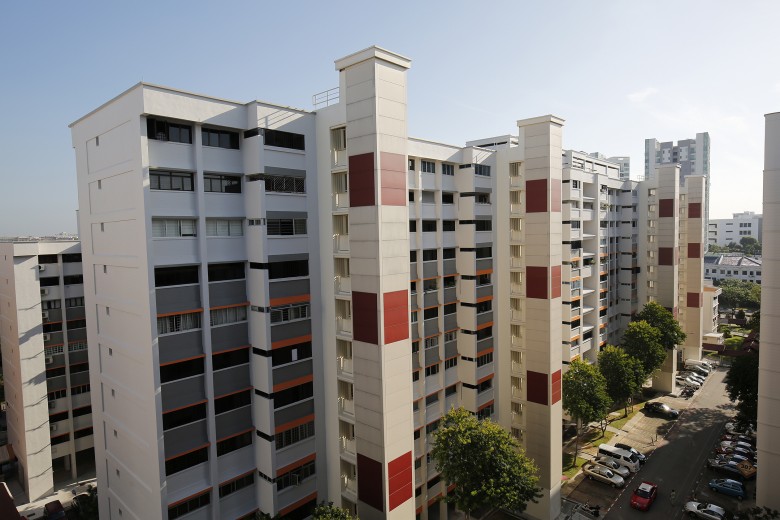
Public housing is an inextricable part of life in Singapore today. Its unique relevance extends beyond its housing imperative into the social, political and demographic spheres of Singapore society. Public flats in Singapore are more than just homes, as they have been tied to larger policy objectives such as building a sense of community and national pride, and encouraging marriage and the creation of families.
As of 2014, 82% of Singapore residents lived in Housing & Development Board (HDB) flats. Over nine in 10 of these HDB residents own their own flats after decades of sustained efforts by the government to promote home ownership. This is a source of national pride. Married couples have also traditionally been given perks and priority in obtaining newly-built HDB flats.
The HDB flat is an important asset of many Singapore residents. As much as 95.1% of public housing owners financed their flat purchases with their CPF funds, which is Singapore’s main mechanism of social security. But as a 99-year leasehold property, HDB flats will certainly reach zero value once the 99-year lease is up. Deputy Prime Minister Tharman Shanmugaratnam, in his Budget 2014 debate round-up speech last year, highlighted how two-thirds of our HDB flats will be 30 years or older by 2020. In a January 2014 exchange in Parliament, National Development Minister Khaw Boon Wan said, “Like all leasehold properties, HDB flats will revert to HDB, the landowner, upon expiry of their leases.”
Mr Khaw added that the Selective En Bloc Redevelopment Scheme (SERS) — where older estates are demolished, and compensation and new housing subsidies are offered to displaced residents to buy flats in a nearby area — was contingent on several factors. This included “their redevelopment potential, and the availability of replacement sites for rehousing and other resources.”
This essay highlights the depreciation attribute of leasehold HDB flats, before looking at some of the possible implications of this on different groups of Singapore homeowners.
Illustrating the depreciation of HDB flats
Determining the monetary effects of depreciation of HDB flats is difficult, especially for assets with a short history of existence like HDB flats because there is yet a market to help price the depreciation schedule.
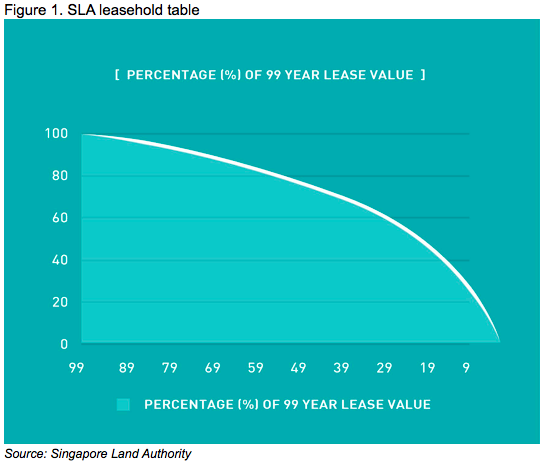
To illustrate depreciation, we generated a hypothesised depreciation schedule based on the Singapore Land Authority’s (SLA) leasehold table for calculating development charges for land leased out by the state. We did this since land and property are two closely related assets. We note though that the SLA leasehold table does not take into account factors affecting the pricing of HDB flats such as enhancements to the flat and neighbourhood, population expansion and the performance of the Singapore economy. Hence, it may not be reflective of observable market price movements today.
The graph below is based on the SLA leasehold table, with the values adjusted so that the 99-year leasehold land becomes the base year. As presented in the figure, as the lease of the land declines, its relative value drops too. What the curve represents is the depreciation schedule of a leasehold plot estimated by SLA. At the end of 99 years, because the land reverts back to SLA, it would not retain any value.
Table-1-99year-lease-value
Assuming that the depreciation schedule of a HDB flat takes on the same curve as the one presented by the SLA leasehold table above, the theoretical depreciated value 30 years from now of a resale HDB flat with 80 years of lease remaining would be 82.1% of today’s valuation. If the flat has only 70 years of lease remaining, the theoretical depreciated value in 30 years’ time would be 79.6% of today’s valuation.
The key point to note is that while the value of the flat 30 years later will be lower than today’s value, the flat with fewer lease years remaining at the point of purchase experiences an accelerating decline in value as time passes when the remaining lease term drops below 50 years.
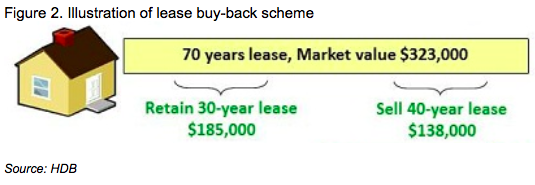
An example of tail-end lease monetisation under the lease buy-back scheme provided by the HDB is also instructive. The lease buy-back scheme is one option provided by the HDB to help older homeowners monetise their HDB flat.
Lease-buy-back-scheme
In the HDB’s example, for a flat with 70 years left on its lease and a market value of $323,000, the present value of the 40-year tail-end lease is worth $138,000 or 42.7% of the flat’s market value. Using the theoretical future value derived from the SLA leasehold table, this implies a 2.1% discount rate. This discount rate seems reasonable when compared to HDB concessionary interest rate (2.6%) and CPF ordinary account floor interest rate (2.5%). However, by accepting this lease buy-back scheme, the homeowner is foregoing the possibility of reselling the flat during the retained 30 years of lease term.
In this sense, it is important to recognise that many different depreciation schedules can be used, but it is impossible to ascertain which one is the most appropriate since there are no existing markets to price ageing HDB flats yet (for example, there are no futures market to price the value of a HDB flat with only 10 years of lease left).
While the exact pathway of property price movement cannot be determined, it is irrefutable that HDB flats, being 99-year leasehold assets, will eventually depreciate in value as the lease reaches expiration. As such, there will come a point in time when the price of an ageing HDB flat reaches an inflection point as the erosive effects of HDB lease depreciation act as an ever-increasing drag on residents’ housing equity. This is especially critical when retirement nest eggs are particularly concentrated in this asset class. What are the implications for the vast population of HDB flats owners then when the country segues into this new public housing paradigm?
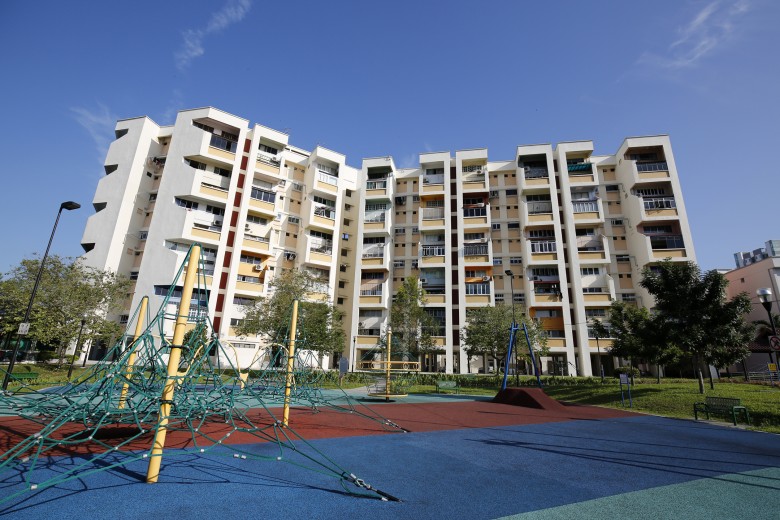
Photo by Alan Yeo_Commons piece on Depreciation of HDB
Implications
Given how embedded Singapore’s public housing is in the fabric of society, depreciating values of ageing HDB flats will likely have social, political and economic implications. The remaining discussion in this essay will focus on the economic implications for HDB flats owners, and in particular on the impact of a depreciating HDB asset on the financial health of the individual.
For brevity, we look at two constructed scenarios to examine the possible implications as the end of the 99-year lease term approaches.
In the first scenario, a young couple in their early 30s sell their Build-to-Order (BTO) flat after their Minimum Occupation Period (MOP), allowing them to “cash out” the various housing grants they were eligible for when they first purchased the flat, and delve into the resale market. They then purchase a mature HDB with 60 years remaining on its lease, hoping to benefit from future upside capital gains.
Tangentially, a single person above 35 who purchases his/her first property in the resale HDB market does so for the same reasons, without the benefit of having had previous housing grants and not being eligible for the CPF Housing Grant for singles due to a monthly salary above $5,000.
There is the possibility that by the time both groups of people retire in 30 years’ time and want to monetise their assets, the value of the house with only 30 plus years lease remaining would have declined significantly due to depreciation effects. This could affect them greatly if the property represents a substantial portion of their wealth, with the single person likely to be more affected, as he or she did not benefit from prior housing grants.
In the second scenario, an elderly retired couple in their 60s purchase a similar resale flat with 60 years remaining on its lease. Their intention is to spend the rest of their golden years in the flat before passing it on to their children, not considering the effects of lease decay. There is thus also the possibility of dampening intergenerational wealth transfers.
There are other scenarios that can be fleshed out. But the examples above put across a plain fact: people who do not take into account the negative wealth effects from HDB depreciation could find themselves in more adverse financial situations in future.
HDB flat buyers will have to consider the issue of lease decay when buying a HDB flat. They should realise the effects of depreciation of their HDB asset on their potential retirement fund. Policymakers on their part should educate the public on the implications of leasehold property depreciation, and provide timely, accurate and salient information about property prices to enhance the efficiency of the resale property market, like what is happening now with revisions to the resale price index. In addition, it may be necessary put in place certain social measures to help individuals who may unfortunately get caught on the wrong foot by the effects of HDB depreciation.

IPS - Published on 9 Feb, 2015
Chang Zhi Yang is a Research Assistant in the Economics and Business cluster and Andrew Yeo is a Research Assistant (Special Projects) at IPS.
Photos by Alan Yeo